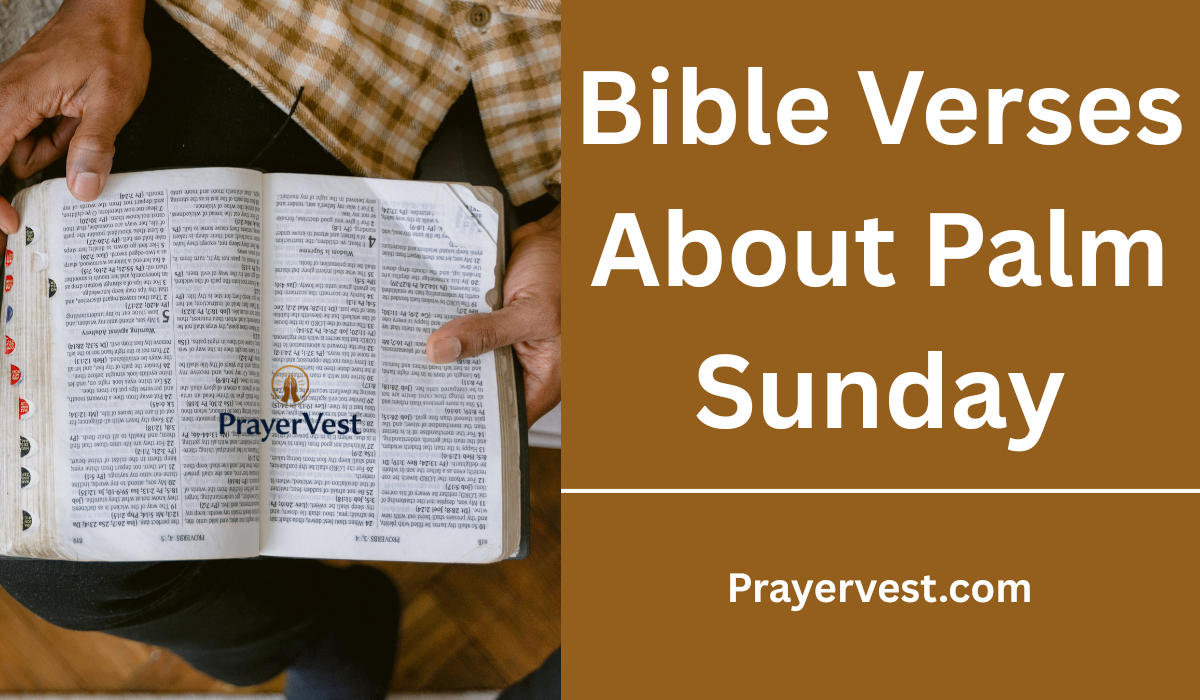
Bible Verses About Palm Sunday. A crucial and emotionally charged event in the Christian calendar, Jesus’ triumphant entry into Jerusalem exactly one week before his resurrection, is commemorated on Palm Sunday. The event is a rich tapestry of spiritual expectation, dramatic contrast, and prophetic fulfillment that is painstakingly documented in all four Gospels.
The masses welcomed Jesus like a conquering king rather than a modest rabbi as he entered the city on a young donkey. By laying down their cloaks, chopping branches from the palm trees, waving them, and yelling praises, the people announced his presence. These acts were a direct, if imperfect, fulfillment of the predictions recorded in the Old Testament, especially Zechariah 9:9, and were highly symbolic, reflecting the customs of receiving royalty and military conquerors.
The crowd’s exuberant yet brittle joy is captured in the Bible texts describing Palm Sunday. Their joyful shouts of “Hosanna!”—a Hebrew word that means “save (us) now”—exhibited a feverish expectation that Jesus would soon free people from Roman tyranny and create a political kingdom on earth. The act of waving palm branches itself was strongly associated with Jewish pride in their country and their successful uprising against foreign rulers.
But the event’s real significance was found in the harsh irony of its setting. Jesus’ doom was sealed by the same adoration and expectation that greeted him as a political savior, laying the groundwork for the abrupt change of allegiance that would result in his arrest and death a few days later.
In the end, the words pertaining to Palm Sunday function as a potent theological link between the reality of the New Covenant and the hope of the Old. They portray Jesus not just as the promised King but also as the selfless Lamb who voluntarily entered the city to carry out his mission. Jesus quietly reinterpreted the nature of his kingdom by riding a donkey instead of a warhorse: a reign founded on nonviolent suffering, humility, and ultimate self-sacrifice rather than military strength. The narrative serves as a timeless lesson about misplaced expectations and the profound reality that God’s redemptive power frequently shows up in the way we most urgently need rather than the way we want.
40 Inspiring Bible Verses About Palm Sunday (2026)
1. Zechariah 9:9
“Rejoice greatly, Daughter Zion! Shout, Daughter Jerusalem! See, your king comes to you, righteous and victorious, lowly and riding on a donkey, on a colt, the foal of a donkey.”
This foundational prophetic verse establishes the ancient promise of the Triumphal Entry. It describes the Messiah’s dual nature: “victorious” yet “lowly,” arriving not on a warhorse but on a humble donkey. This prophecy defined the entire event, confirming that Jesus was intentionally fulfilling Scripture by choosing this specific mode of transportation.
2. Matthew 21:2
“ ‘Go to the village ahead of you, and at once you will find a donkey tied there, with her colt by her. Untie them and bring them to me.’ ”
This verse highlights Jesus’ sovereign, foreknowledge and intentional preparation for the event. Jesus instructs his disciples with precise details about finding the animals, demonstrating His divine control over the circumstances. This command emphasizes that the Entry was not a spontaneous accident but a carefully orchestrated step in His redemptive plan.
3. Matthew 21:4
“This took place to fulfill what was spoken through the prophet, saying…”
This crucial transitional verse explicitly declares the event’s primary purpose: the fulfillment of prophecy. Matthew immediately interrupts the narrative to draw a direct line between Jesus’ actions and the Old Testament. It underscores the theological significance of the event for all who read the account, proving Jesus’ Messianic claims.
4. Matthew 21:7
“They brought the donkey and the colt and placed their cloaks on them for Jesus to sit on.”
This action-oriented verse shows the disciples’ immediate obedience and their personal contribution to the royal procession. Lying their own cloaks onto the animals was an act of personal honor and dedication, ritually preparing the seat for a king. It demonstrates the disciples’ full belief in Jesus’ sovereign authority at that moment.
5. Mark 11:8
“Many spread their cloaks on the road, while others spread branches they had cut in the fields.”
This verse details the crowd’s enthusiastic, symbolic actions of honoring a king. The spreading of cloaks and branches was an ancient sign of welcome reserved for royalty or conquering heroes. The “branches” (likely palm branches, based on John’s account) signified victory and national pride, expressing their collective political and spiritual expectation.
6. Mark 11:9
“Those who went ahead and those who followed shouted, ‘Hosanna! Blessed is he who comes in the name of the Lord!’ ”
This central verse records the crowd’s frenzied, liturgical proclamation of praise and plea for salvation. “Hosanna!” is a combination of praise and a desperate appeal (“Save us now!”). Their shout, drawn from Psalm 118, clearly identifies Jesus as the Messiah who arrives with divine authority, connecting the event directly to Israel’s sacred history.
7. John 12:13
“They took palm branches and went out to meet him, shouting, ‘Hosanna! Blessed is the king of Israel who comes in the name of the Lord.’ ”
This verse specifically mentions the palm branches as symbols of Jewish victory and nationalistic aspiration. The crowd’s direct declaration of Jesus as the “King of Israel” reveals their belief that He was the long-awaited political ruler destined to overthrow Rome. The palm branch further emphasizes this expectation of earthly triumph.
8. Luke 19:40
“ ‘I tell you,’ he replied, ‘if they keep quiet, the stones will cry out.’ ”
This verse provides Jesus’ bold defense and validation of the crowd’s exuberant worship. When challenged by the Pharisees to quiet the crowd, Jesus asserts that His entry as King is so fundamental to God’s plan that the very creation would bear witness if humans remained silent. This affirms the divine necessity and significance of the Triumphal Entry.
9. John 12:16
“At first his disciples did not understand all this. Only after Jesus was glorified did they realize that these things had been written about him and that these things had been done to him.”
This reflective verse reveals the disciples’ initial spiritual blindness and the later, post-resurrection understanding of the event. The disciples’ lack of understanding underscores the profound theological depth of the event—it was much more than a simple parade. It was only after the Resurrection (“Jesus was glorified”) that the full prophetic meaning was grasped.
10. Luke 19:42
“ ‘If you, even you, had only known on this day what would bring you peace—but now it is hidden from your eyes.’ ”
This poignant verse captures Jesus’ immediate, sorrowful lament over the city’s spiritual blindness. Immediately after receiving their adoration, Jesus weeps over Jerusalem, recognizing that while they acclaimed Him as King, they failed to recognize the true, peaceful nature of His salvation. This foretells the coming judgment and the subsequent shift from “Hosanna” to “Crucify Him.”
11. Matthew 21:10
“When Jesus entered Jerusalem, the whole city was stirred and asked, ‘Who is this?’ ”
This verse illustrates the widespread public impact and genuine uncertainty caused by the Entry. The arrival of Jesus did not go unnoticed; it created a disturbance that prompted questions across the city. This inquiry serves as a crucial theological moment, forcing both the reader and the historical observer to grapple with Jesus’ identity.
12. Matthew 21:11
“The crowds answered, ‘This is Jesus, the prophet from Nazareth in Galilee.’ ”
This verse reveals the crowd’s public but incomplete acknowledgment of Jesus’ identity. While recognizing Him as a highly respected figure—a “prophet”—the people still attach Him to His humble origins in Nazareth. This answer highlights the gap between their enthusiastic welcome and a full, saving belief in His Messianic kingship.
13. John 12:15
“ ‘Do not be afraid, Daughter Zion; see, your king is coming, seated on a donkey’s colt.’ ”
This verse reinforces the theme of peace and fearlessness associated with the arrival of the King. By quoting Zechariah, the text encourages “Daughter Zion” (the people of Jerusalem) to dismiss fear, as their King arrives humbly on a colt. It frames the Entry as an assurance of peace, contrasting the violence expected of a typical conquering king.
14. Mark 11:10
“ ‘Blessed is the coming kingdom of our father David!’ ”
This specific acclamation emphasizes the crowd’s focus on historical restoration and political hope. Their cry directly references the lineage of King David, signaling their primary desire for the immediate re-establishment of a sovereign, independent Jewish state under the rule of the Messiah. This further clarifies the popular, earthly interpretation of the Entry.
15. Matthew 21:8
“A very large crowd spread their cloaks on the road, while others cut branches from the trees and spread them on the road.”
This verse emphasizes the scale and celebratory nature of the crowd’s spontaneous worship. The description of a “very large crowd” underscores the massive, visible testimony being offered to Jesus. Their collective use of cloaks and branches created a makeshift, royal carpet for the Messiah.
16. John 12:12
“The next day the great crowd that had come for the festival heard that Jesus was on his way to Jerusalem.”
This verse establishes the high religious context and timing of the Triumphal Entry. It occurred the day after Jesus arrived in Bethany, utilizing the presence of the “great crowd” that had gathered for the Passover festival. This large, diverse, and religiously fervent audience ensured maximum public exposure for the event.
17. Luke 19:35
“They brought it to Jesus, threw their cloaks on the colt and put Jesus on it.”
This verse again highlights the immediate, servant-hearted action of the disciples in preparing the mount. The practical act of covering the colt with their cloaks not only provided a seat for Jesus but demonstrated a deep sense of humility and service to their Master, placing their possessions beneath His authority.
18. Luke 19:36
“As he went along, people spread their cloaks on the road.”
This concise verse captures the central, repeated act of recognition and public homage. The spreading of the cloaks throughout the route signifies a continuous, flowing act of submission by the people. It transforms the public road into a royal procession path, visually confirming their momentary allegiance to the “King.”
19. Luke 19:38
“ ‘Blessed is the king who comes in the name of the Lord! Peace in heaven and glory in the highest!’ ”
This unique acclamation in Luke’s account provides a celestial, heavenly interpretation of the event. The crowd’s shout expands the focus from earthly salvation to “Peace in heaven and glory in the highest,” suggesting a realization that Jesus’ arrival had cosmic and spiritual significance beyond mere political liberation.
20. Matthew 21:12
“Jesus entered the temple courts and drove out all who were buying and selling there. He overturned the tables of the money changers and the benches of those selling doves.”
This verse details the immediate, powerful action taken by the King upon entering His domain. Following the Triumphal Entry, Jesus’ first act is to cleanse the Temple. This act of righteous indignation and authority confirms that His kingship is focused first and foremost on the purity and true purpose of worship.
21. Luke 19:37
“When he came near the place where the road goes down the Mount of Olives, the whole crowd of disciples began joyfully to praise God in loud voices for all the miracles they had seen.”
This verse locates the geography and the cause of the spontaneous outbreak of worship. The disciples’ praise, initiated on the descent of the Mount of Olives, was not solely about prophecy but was fueled by their remembrance of “all the miracles” they had witnessed. This validates the Entry as a natural, emotional response to Jesus’ divine power.
22. John 12:17-18
“Now the crowd that had been with him when he called Lazarus from the tomb and raised him from the dead continued to spread the word. Many people, because they had heard that he had performed this sign, went out to meet him.”
This verse explains the immediate, miraculous catalyst for the massive crowd’s attendance. The recent, widely reported miracle of raising Lazarus was the direct reason many people rushed out to meet Jesus. This links the Entry not just to kingship, but to the ultimate demonstration of life-giving power over death.
23. Matthew 21:14
“The blind and the lame came to him at the temple, and he healed them.”
This verse shows the King’s merciful actions immediately following the cleansing of the Temple. After establishing His authority by driving out the merchants, Jesus uses the purified space for healing. This demonstrates that His kingship is defined not only by judgment and holiness but also by compassion and restorative power.
24. Matthew 21:15
“But when the chief priests and the teachers of the law saw the wonderful things he did and the children shouting in the temple courts, ‘Hosanna to the Son of David,’ they were indignant.”
This verse highlights the immediate, indignant opposition to Jesus’ authority and worship. The religious leaders were not moved by the “wonderful things” (healings), but were outraged by the children’s spontaneous, theologically loaded cry of “Hosanna to the Son of David.” This confirmed their rejection of His Messianic claim.
25. Matthew 21:16
“ ‘Do you hear what these children are saying?’ they asked him. ‘Yes,’ replied Jesus, ‘have you never read, “From the lips of children and infants you, Lord, have called forth your praise”?’ ”
This verse provides Jesus’ sharp, scriptural defense of the children’s worship. Jesus silences His critics by quoting Psalm 8, validating the worship of the marginalized and implicitly rebuking the leaders for their spiritual blindness. He asserts that the praise being offered is divinely ordained and undeniable.
26. Luke 19:44
“ ‘They will dash you to the ground, you and the children within your walls. They will not leave one stone on another, because you did not recognize the time of God’s coming to you.’ ”
This verse further details Jesus’ weeping and prophetic warning about the city’s future destruction. The judgment is tied directly to their failure to recognize Him as the Messiah—the true source of peace—during the Triumphal Entry. This underscores the event’s gravity as a critical, unheeded moment of visitation.
27. Mark 11:11
“Jesus entered Jerusalem and went into the temple. He looked around at everything, but since it was already late, he went out to Bethany with the Twelve.”
This verse captures the somber, scrutinizing gaze of the King upon His domain. After the fanfare of the entry, Jesus performs a quiet, intense inspection of the Temple before retiring. This “look around” is a silent, preliminary judgment that sets the stage for the dramatic cleansing the following morning.
28. John 12:19
“So the Pharisees said to one another, ‘See, this is getting us nowhere. Look how the whole world has gone after him!’ ”
This verse reveals the frustrated acknowledgment of Jesus’ overwhelming popular appeal by His critics. The Pharisees recognized that their efforts to contain Jesus were failing, as the Entry had successfully drawn “the whole world” (i.e., vast numbers of pilgrims) to Him. This despair highlights the power of the event.
29. Matthew 21:17
“And he left them and went out of the city to Bethany, where he spent the night.”
This verse details Jesus’ practical separation from the city’s politics and dangers. Leaving the intense atmosphere of Jerusalem each evening for the peace of Bethany (the home of Lazarus, Mary, and Martha) was a strategic move, signifying His control and preparation for the spiritual battles of the coming week.
30. Luke 19:28
“After Jesus had said this, he went on ahead, going up to Jerusalem.”
This verse acts as the narrative transition, emphasizing Jesus’ deliberate and resolved movement toward His destiny. The phrase “going up to Jerusalem” signals that Jesus was willingly initiating the final, fatal sequence of events. The Triumphal Entry was not an accidental occurrence but a conscious, purposeful step toward the Cross.
31. Luke 19:39
“Some of the Pharisees in the crowd said to Jesus, ‘Teacher, rebuke your disciples!’ ”
This verse highlights the immediate, legalistic attempt by the religious authorities to suppress worship. The Pharisees’ command for Jesus to “rebuke” the disciples reveals their rejection of the Messianic claims inherent in the celebration. They sought to silence the recognition of Jesus’ sovereignty.
32. Psalm 118:25-26
“Lord, save us! Lord, grant us success! Blessed is he who comes in the name of the Lord.”
This Old Testament text, which the crowd quoted, demonstrates the deep scriptural roots and the traditional Jewish context of the “Hosanna” shout. The people were using a traditional liturgy for national deliverance and Messianic welcome. This validates their choice of words as a sincere, if misdirected, prayer.
33. John 12:33
“He said this to show the kind of death he was going to die.”
While not directly about the Entry, this verse, which immediately follows a discussion of Jesus’ “lifting up” (referencing the Cross), provides the ultimate interpretive key to the week’s events. It shows that Jesus viewed every public action, including the Entry, through the lens of His approaching sacrificial death, thus redefining the “Triumphal Entry” as a prelude to His victory on the cross.
34. Zechariah 14:4
“On that day his feet will stand on the Mount of Olives, east of Jerusalem, and the Mount of Olives will be split in two from east to west.”
This prophetic verse, though concerning the Second Coming, adds eschatological weight and significance to the Entry’s physical location. By beginning the procession on the Mount of Olives, Jesus was consciously standing in the place designated for the future return and judgment of the Messiah, underscoring the seriousness of His visitation.
35. Matthew 21:13
“ ‘It is written,’ he said to them, ‘ “My house will be called a house of prayer,” but you have made it “a den of robbers.” ’ ”
This verse, delivered after the Temple cleansing, reinforces the King’s priority for true worship and spiritual mission over commercialism. Jesus uses Scripture to justify his forceful action, proving that His authority upon entering Jerusalem was immediately focused on reforming the spiritual life of His people.
36. John 12:1
“Six days before the Passover, Jesus came to Bethany, where Lazarus lived, whom Jesus had raised from the dead.”
This verse establishes the chronological start of the Passion Week in the context of the Passover. It sets the stage for the Entry by fixing the timing precisely one week before the ultimate sacrifice, emphasizing that every subsequent event was purposefully aligned with the timeline of Jewish redemption.
37. Matthew 21:1-2 (The Donkey’s Uniqueness)
“As they approached Jerusalem and came to Bethphage on the Mount of Olives, Jesus sent two disciples, saying to them, ‘Go to the village ahead of you, and at once you will find a donkey tied there, with her colt by her. Untie them and bring them to me.’ ”
This section emphasizes the use of two animals to fulfill prophecy with precise detail. The reference to the mother donkey and the colt was essential to match the Zechariah prophecy literally, demonstrating the minute care Jesus took to ensure the event was recognized as scriptural fulfillment.
38. Mark 11:7
“When they brought the colt to Jesus and threw their cloaks over it, he sat on it.”
This verse confirms the simplicity and humility of the King’s mount. The singular focus on the colt (the young, unbroken animal) emphasizes the “lowly” aspect of the prophecy. Jesus was content to ride the most humble mount, symbolically rejecting the ostentation of a conquering earthly sovereign.
39. Luke 19:43
“The days will come upon you when your enemies will build an embankment against you and encircle you and hem you in on every side.”
This verse provides further detail on the nature of the prophetic judgment over Jerusalem. It is a stark warning of the Roman siege (fulfilled in AD 70), reminding the crowd that by failing to accept the King of Peace during the Entry, they chose a path that inevitably led to violent destruction.
40. Mark 11:15
“On reaching Jerusalem, Jesus entered the temple courts and began driving out those who were buying and selling there.”
This verse reiterates the forceful manifestation of Christ’s authority immediately after the public declaration of His kingship. The cleansing of the Temple is the immediate, practical, and dramatic response to the “Hosanna,” proving that Jesus’ primary concern was spiritual purification and authentic worship, not political revolution.
Conclusion
The Bible passages depicting Palm Sunday capture the paradoxical character of Christ’s sovereignty, not just a historical procession. The people’s longing for a political Messiah who would use an iron fist against Rome was symbolized by the yells of “Hosanna!” and the palm waving. However, Jesus purposefully defied these expectations by riding a donkey, a symbol of peace and modest monarchy that fulfilled Zechariah’s prophecy. This signified that his actual authority was spiritual rather than geopolitical and that sacrifice rather than conflict would be the means of his eventual victory.
The Palm Sunday lines’ lasting influence ultimately stems from their function as Holy Week’s dramatic opening act. They compel us to consider our own expectations of Christ: do we want the Savior who humbly rides toward the cross for our eternal salvation, or the King who rides in for earthly convenience? The path Jesus took right after, heading toward the temple to teach and finally accepting his fate, is the story’s last word rather than the first applause. Therefore, Palm Sunday is an invitation to acknowledge Jesus not only as the crowned King of Jerusalem but also as the selfless King whose rule is characterized by redeeming love and the deep humility displayed on a dusty road.